

“Male detainee needs to go out due to head trauma,” an employee at a U.S. Immigration and Customs Enforcement’s detention center in Georgia tells a 911 operator.
The operator tells the employee at Stewart Detention Center that there are no ambulances available.
“It’s already out — on the last patient y’all called us with,” the operator says.
“Is there any way you can get one from another county?” the caller asks.
“I can try,” the operator says. “I can’t make any promises, but I can try.”
Listen to the 911 call
The call was one of dozens from the ICE detention facility seeking help with medical emergencies during the first 10 months of the second Trump administration, a sustained period of high call volume from the jail not seen since 2018.
Emergency calls were made to 911 at least 15 times a month from Stewart Detention Center for six months in a row as of November 1.
Like the call concerning a detainee’s head trauma from April 1, emergency dispatch records show that the ambulance service in Stewart County, Georgia, where the detention center is located, has had to seek help outside the county more than any time in at least five years — including three instances in November alone.
The burden on rural Stewart County’s health care system is “unsustainable,” said Dr. Amy Zeidan, a professor of emergency medicine at Atlanta’s Emory University who researches health care in immigration detention.
“People are going to die if they don’t get medical care,” said Zeidan. “All it takes is one person who needs a life-saving intervention and doesn’t have access to it.”
“People are going to die if they don’t get medical care.”
This continuous barrage of calls for help with acute medical needs reflects increased detainee populations without changes to medical staffing and capacities, experts told The Intercept. Shifting detainee populations, they said, may also be exacerbating the situation: Older immigrants and those with disabilities or severe health issues used to be more frequently let out on bond as their cases were resolved, but ICE’s mass deportation push has led to an increase in their detention.
With the number of people in immigration detention ballooning nationwide, health care behind bars has become an issue in local and state politics. In Washington state, for instance, legislators passed a law last year giving state-level authorities more oversight of detention facilities. A recent court ruling granted state health department officials access to a privately operated ICE detention center to do health inspections. (A spokesperson from Georgia’s health department did not answer questions about the high volume and types of calls at Stewart.)
911 calls from Stewart included several for “head trauma,” such as one case where an inmate was “beating his head against the wall” and another following a fight.
Impacts of the situation are hard to measure in the absence of comprehensive, detailed data, but they extend both to Stewart’s detainee population — which has increased from about 1,500 to about 1,900 during the Trump administration — and to the surrounding, rural county. (ICE did not respond to a request for comment.)
The data on 911 calls represent what Dr. Marc Stern, a consultant on health care for the incarcerated, called “a red flag.”
Illness and Injuries
Data obtained by The Intercept through open records requests shows that the top four reasons for 911 calls since the onset of the second Trump administration have been chest pains and seizures, with the same number of calls, followed by stomach pains and head injuries.
Neither written call records nor recordings of the calls themselves offer much insight into the causes of injuries. One cause of head traumas, though, could be fights between detainees, said Amilcar Valencia, the executive director of El Refugio, a Georgia-based organization that works with people held at Stewart and their families and loved ones.
“It’s not a secret that Stewart detention center is overcrowded,” he said. “This creates tension.”
Issues such as access to phones for calls to attorneys or loved ones can lead to fights, he said.
Another issue may be self-harm, suggested testimony from Rodney Scott, a Liberian-born Georgia resident of four decades who has been detained in Stewart since January. One day in September, Scott, who is a double amputee and suffers high blood pressure and other health issues, said he saw a fellow detainee climb about 20 stairs across a hall from him and jump over a railing, landing several stories below.
“He hit his head,” Scott said. “It was shocking to see someone risk his life like that.”
He doesn’t know what happened to the man.
On another day, about a month earlier, Scott saw a man try to kill himself with razors.
“He went in, cut himself with blades, after breakfast,” Scott said. “There was a pool of blood,” he said. “It looked like a murder scene.”
In addition to interpersonal tensions, large numbers of detainees in crowded conditions can strain a facility’s medical capacities.
“People are becoming sicker than what the system can handle.”
“There’s a mismatch between the number of people and health workers,” said Joseph Nwadiuko, a professor of medicine at the University of Pennsylvania who researches the immigration detention system. “People are becoming sicker than what the system can handle. The complexity of patients is above and beyond what Stewart is prepared for.”
CoreCivic, the company that operates Stewart, is currently advertising to hire a psychiatrist, a dental assistant, and two licensed practical nurses at the detention center.
In response to a request for comment, Brian Todd, a spokesperson for CoreCivic, said, “We are grateful to the emergency responders who provide medical assistance when deemed necessary by the health care professionals at SDC, however, we have no control over the local EMS staffing levels, and their decisions to refer calls to outside jurisdictions.”
The company did not respond to questions about medical staffing at Stewart.
“A Lack of Accountability”
The situation at hand also potentially impacts the residents of Stewart County, a sprawling tract of about 450 square miles in southwest Georgia. About 28 percent of the county’s nearly 5,000 residents, two-thirds of whom are Black, live below the poverty line.
The county has two ambulances, and there are no hospitals. The nearest facilities equipped to handle calls coming from the ICE detention center are in neighboring counties about 45 minutes to the east or nearly an hour north. County Manager Mac Moye, though, was nonplussed when presented with the data on the sustained high volume of 911 calls from the detention center.
“We are in a very rural, poor county, with very low population density,” he said. “We’ve always had slow responses compared to, let’s say, Columbus” — the city of 200,000 nearly 45 miles north where one of the nearest hospitals is located.
“We run two ambulances; most surrounding counties have one,” he continued. “We have more money, because of Stewart” — the detention center.
The ICE facility paid nearly $600,000 in fees in fiscal year 2022, the latest year for which data is available, or about 13 percent of the county’s general fund of $4.4 million.
Moye, who worked at the detention center before taking his current job, also called into question whether 911 calls were always made for legitimate reasons. The county manager did not comment on whether his own constituents are increasingly more at risk in situations like the one on April 1, when no ambulance was available to answer a call from the detention center.
“It’s still faster than if we had one ambulance,” he said. “We wish we would never have to call another county, and deal with every call on our own.”
As for the conditions facing detainees, particularly given the types of emergencies the detention center calls 911 about, Moye said, “It’s difficult to comment on what’s happening over there, because we don’t have any control over it.”
That points to a larger problem reflected in the increased calls.
“Obviously, a prison is a prison — it’s blind to the rest of the world,” said Nwadiuko, the Penn professor. “There’s a moral hazard for conditions that don’t occur elsewhere, a lack of accountability.”
“Do No Harm”?
“Seizures, chest pains — are they preventable? Why is it happening?” said Stern, the doctor who consults on carceral health care, commenting on the high volume and types of calls. “Could mean that access or the quality of care is poor. It’s a red flag if the number is high or increasing, and it indicates that investigation is required.”
In September, Democratic Georgia Sens. Raphael Warnock and Jon Ossoff sent a letter to Homeland Security Secretary Kristi Noem and ICE Acting Director Todd Lyons expressing concern over the 14 deaths in ICE custody this year, including Jesus Molina-Veya, whose June 7 death at Stewart has been reported as a suicide.
The letter sought answers to a series of detailed questions by October 31 about the care Stewart and other ICE detention centers are providing to detainees. Warnock and Ossoff’s offices said they have not received a reply. Ossoff also released an investigation in October called “Medical Neglect and Denial of Adequate Food or Water in U.S. Immigration Detention” that included information gathered at Stewart.
Zeidan, the Emory professor, noted that there’s little information about what happens to ICE detainees once they reach a hospital.
“What happens after detainees are admitted?” Zeidan said. “Are they discharged? Are they getting comprehensive, follow-up care?”
Nwadiuko echoed the concern.
“Are doctors and hospitals using good judgment regarding when going back to a detention facility doesn’t mean ‘a safe discharge’?” he said. “We have an oath: ‘Do no harm.’ That may conflict with an institution’s desire to minimize a detainee’s time outside the gates of the detention center.”
Update: December 15, 2025
This story has been updated to include a statement from CoreCivic received after publication.
IT’S EVEN WORSE THAN WE THOUGHT.
What we’re seeing right now from Donald Trump is a full-on authoritarian takeover of the U.S. government.
This is not hyperbole.
Court orders are being ignored. MAGA loyalists have been put in charge of the military and federal law enforcement agencies. The Department of Government Efficiency has stripped Congress of its power of the purse. News outlets that challenge Trump have been banished or put under investigation.
Yet far too many are still covering Trump’s assault on democracy like politics as usual, with flattering headlines describing Trump as “unconventional,” “testing the boundaries,” and “aggressively flexing power.”
The Intercept has long covered authoritarian governments, billionaire oligarchs, and backsliding democracies around the world. We understand the challenge we face in Trump and the vital importance of press freedom in defending democracy.
We’re independent of corporate interests. Will you help us?
IT’S BEEN A DEVASTATING year for journalism — the worst in modern U.S. history.
We have a president with utter contempt for truth aggressively using the government’s full powers to dismantle the free press. Corporate news outlets have cowered, becoming accessories in Trump’s project to create a post-truth America. Right-wing billionaires have pounced, buying up media organizations and rebuilding the information environment to their liking.
In this most perilous moment for democracy, The Intercept is fighting back. But to do so effectively, we need to grow.
That’s where you come in. Will you help us expand our reporting capacity in time to hit the ground running in 2026?
We’re independent of corporate interests. Will you help us?

I’M BEN MUESSIG, The Intercept’s editor-in-chief. It’s been a devastating year for journalism — the worst in modern U.S. history.
We have a president with utter contempt for truth aggressively using the government’s full powers to dismantle the free press. Corporate news outlets have cowered, becoming accessories in Trump’s project to create a post-truth America. Right-wing billionaires have pounced, buying up media organizations and rebuilding the information environment to their liking.
In this most perilous moment for democracy, The Intercept is fighting back. But to do so effectively, we need to grow.
That’s where you come in. Will you help us expand our reporting capacity in time to hit the ground running in 2026?
We’re independent of corporate interests. Will you help us?
Contact the author:
Related

Feds Say Kat Abughazaleh “Impeded” ICE Agents. That Would Put Her on the Right Side of History.

Chinese ICE Detainee Dies by Suicide at Pennsylvania Detention Center
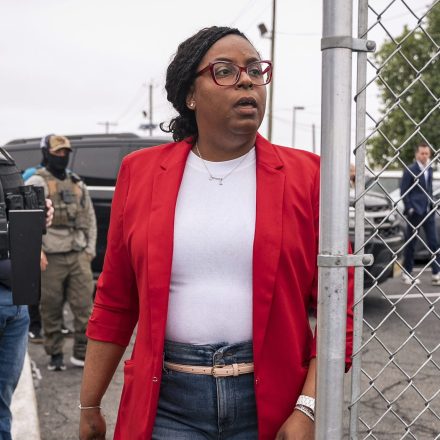
Trump Is Prosecuting a Congressional Democrat for Doing Her Job. The Media’s Response: No Big Deal.
Private Prison CEO on ICE Contracts: We’re a Better Deal Than El Salvador’s CECOT
Latest Stories

License to Kill
CIA Was Behind Venezuela Drone Strike, Source Says
The December 24 drone strike in Venezuela is the latest in a long tradition of CIA interventions in Latin America — which often lead to destabilization and blowback.

Midterms 2026
AIPAC Is Retreating From Endorsements and Election Spending. It Won’t Give Up Its Influence.
The lobbying group is taking a quieter approach this midterms cycle, but it’s still seeking to keep Congress in Israel’s pocket.

License to Kill
Did Trump Just Confess to Attacking Venezuela?
“They have a big plant or a big facility where the ships come from. Two nights ago, we knocked that out. We hit them very hard.”