

The FBI is looking for ways to incorporate artificial intelligence into drones, according to federal procurement documents.
On Thursday, the FBI put out the call to potential vendors of AI and machine learning technology to be used in unmanned aerial systems in a so-called “request for information,” where government agencies request companies submit initial information for a forthcoming contract opportunity.
“It’s essentially technology tailor-made for political retribution and harassment.”
The FBI is in search of technology that could enable drones to conduct facial recognition, license plate recognition, and detection of weapons, among other uses, according to the document.
The pitch from the FBI immediately raised concerns among civil libertarians, who warned that enabling FBI drones with artificial intelligence could exacerbate the chilling effect of surveillance of activities protected by the First Amendment.
“By their very nature, these technologies are not built to spy on a specific person who is under criminal investigation,” said Matthew Guariglia, a policy analyst at the Electronic Frontier Foundation. “They are built to do indiscriminate mass surveillance of all people, leaving people that are politically involved and marginalized even more vulnerable to state harassment.”
The FBI did not immediately respond to a request for comment.
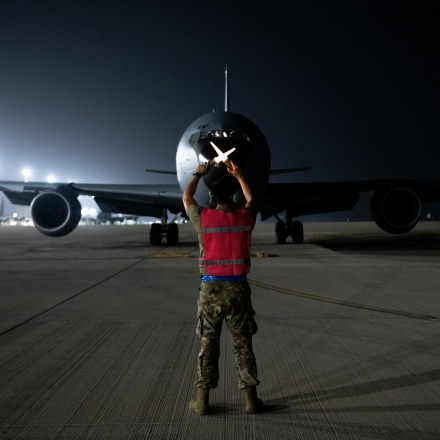
Law enforcement agencies at local, state, and federal levels have increasingly turned to drone technology in efforts to combat crime, respond to emergencies, and patrol areas along the border.
The use of drones to surveil protesters and others taking part in activities ostensibly protected under the Constitution frequently raises concerns.
In New York City, the use of drones by the New York Police Department soared in recent years, with little oversight to ensure that their use falls within constitutional limits, according to a report released this week by the Surveillance Technology Oversight Project.
In May 2020, as protests raged in Minneapolis over the murder of George Floyd, the Department of Homeland Security deployed unmanned vehicles to record footage of protesters and later expanded drone surveillance to at least 15 cities, according to the New York Times. When protests spread, the U.S. Marshals Service also used drones to surveil protesters in Washington, D.C., according to documents obtained by The Intercept in 2021.
“Technically speaking, police are not supposed to conduct surveillance of people based solely on their legal political activities, including attending protests,” Guariglia said, “but as we have seen, police and the federal government have always been willing to ignore that.”
“One of our biggest fears in the emergence of this technology has been that police will be able to fly a face recognition drone over a protest and in a few passes have a list of everyone who attended. It’s essentially technology tailor-made for political retribution and harassment,” he said.
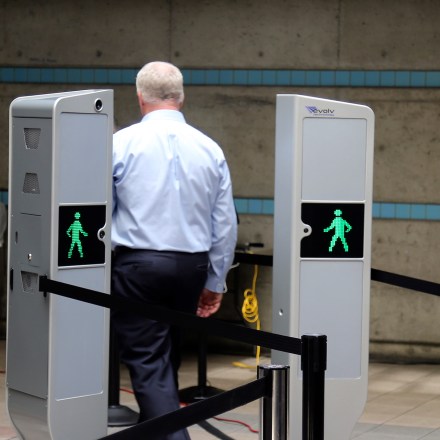
In addition to the First Amendment concerns, the use of AI-enabled drones to identify weapons could exacerbate standoffs between police and civilians and other delicate situations. In that scenario, the danger would come not from the effectiveness of AI tech but from its limitations, Guariglia said. Government agencies like school districts have forked over cash to companies running AI weapons detection systems — one of the specific uses cited in the FBI’s request for information — but the products have been riddled with problems and dogged by criticisms of ineffectiveness.
“No company has yet proven that AI firearm detection is a viable technology,” Guariglia told The Intercept. “On a drone whirling around the sky at an awkward angle, I would be even more nervous that armed police will respond quickly and violently to what would obviously be false reports of a detected weapon.”
IT’S EVEN WORSE THAN WE THOUGHT.
What we’re seeing right now from Donald Trump is a full-on authoritarian takeover of the U.S. government.
This is not hyperbole.
Court orders are being ignored. MAGA loyalists have been put in charge of the military and federal law enforcement agencies. The Department of Government Efficiency has stripped Congress of its power of the purse. News outlets that challenge Trump have been banished or put under investigation.
Yet far too many are still covering Trump’s assault on democracy like politics as usual, with flattering headlines describing Trump as “unconventional,” “testing the boundaries,” and “aggressively flexing power.”
The Intercept has long covered authoritarian governments, billionaire oligarchs, and backsliding democracies around the world. We understand the challenge we face in Trump and the vital importance of press freedom in defending democracy.
We’re independent of corporate interests. Will you help us?
IT’S BEEN A DEVASTATING year for journalism — the worst in modern U.S. history.
We have a president with utter contempt for truth aggressively using the government’s full powers to dismantle the free press. Corporate news outlets have cowered, becoming accessories in Trump’s project to create a post-truth America. Right-wing billionaires have pounced, buying up media organizations and rebuilding the information environment to their liking.
In this most perilous moment for democracy, The Intercept is fighting back. But to do so effectively, we need to grow.
That’s where you come in. Will you help us expand our reporting capacity in time to hit the ground running in 2026?
We’re independent of corporate interests. Will you help us?

I’M BEN MUESSIG, The Intercept’s editor-in-chief. It’s been a devastating year for journalism — the worst in modern U.S. history.
We have a president with utter contempt for truth aggressively using the government’s full powers to dismantle the free press. Corporate news outlets have cowered, becoming accessories in Trump’s project to create a post-truth America. Right-wing billionaires have pounced, buying up media organizations and rebuilding the information environment to their liking.
In this most perilous moment for democracy, The Intercept is fighting back. But to do so effectively, we need to grow.
That’s where you come in. Will you help us expand our reporting capacity in time to hit the ground running in 2026?
We’re independent of corporate interests. Will you help us?
Contact the author:

Related
An NYPD Camera Points Directly Into Their Bedroom. They’re Suing the City Over It.

Donald Trump Jr.’s Drone Ventures Could Make a Killing — Thanks to Dad’s Big Beautiful Budget
How the FBI Sought a Warrant to Search Instagram of Columbia Student Protesters
Hacked Border Surveillance Firm Wants To Profile Drivers, Passengers, and Their “Likely Trip Purpose” In New York City
Latest Stories

License to Kill
CIA Was Behind Venezuela Drone Strike, Source Says
The December 24 drone strike in Venezuela is the latest in a long tradition of CIA interventions in Latin America — which often lead to destabilization and blowback.

Midterms 2026
AIPAC Is Retreating From Endorsements and Election Spending. It Won’t Give Up Its Influence.
The lobbying group is taking a quieter approach this midterms cycle, but it’s still seeking to keep Congress in Israel’s pocket.

License to Kill
Did Trump Just Confess to Attacking Venezuela?
“They have a big plant or a big facility where the ships come from. Two nights ago, we knocked that out. We hit them very hard.”