
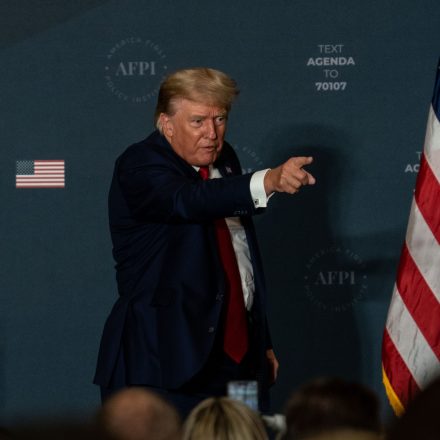
A contingent of Democratic lawmakers rallied Tuesday evening to vote down a controversial bill that would have granted President-elect Donald Trump broad powers to censor and punish his political opponents.
Despite previous bipartisan support, the Stop Terror-Financing and Tax Penalties on American Hostages Act — which would allow the Treasury Department unilateral authority to revoke the tax-exempt status of any nonprofit it designates as a “terrorist supporting organization” — hit a roadblock in Congress in the form of Rep. Lloyd Doggett, D-Texas, who led the charge against the bill in large part due to Trump’s reelection.
“All of us support stopping terrorism,” Doggett said Tuesday. “[But] if he is on a march to make America fascist, we do not need to supply Donald Trump with any additional weapons to accomplish his ill purpose.”
In a vote on the floor of the House of Representatives, 145 Democrats and one Republican voted “nay” — barely enough to deny the bill the two-thirds majority it needed to pass under “suspension of the rules,” a procedure used to fast-track bills with broad bipartisan support.
An earlier version of the bill had passed the House with near unanimous support before it languished in committee in the Senate. It was revived as H.R. 9495 with nearly identical language in September and combined with a similarly stalled provision to provide tax relief to Americans held hostage and unjustly imprisoned abroad.
“H.R. 9495 is a repackaged version of legislation that was originally filed months ago with good intentions, including that of some of my Democratic colleagues,” Doggett said prior to Tuesday’s vote. “With Trump’s election, the conditions have changed; the dangers of granting additional power to him are far outweighed by any benefits from this bill.”
Under the provisions of the bill, the Treasury secretary would have been authorized to unilaterally designate any nonprofit group deemed to be a supporter of terrorism, giving the group just 90 days to respond to a notice. After those 90 days, if appeals were unsuccessful, the group would be stripped of its tax-exempt 501(c)(3) status. Such a measure would likely cripple any nonprofit, and even if an appeal was successful, critics said, it would leave a mark that could scare away donors.
It is already illegal under U.S. law to provide material support for terrorism, a fact that led critics of the bill to label it redundant and politically motivated.

The bill prompted stiff opposition from advocates for civil liberties. A wide array of civil society groups advocated against the measure in a campaign led by the American Civil Liberties Union. Critics worried that the bill was specifically designed to go after pro-Palestine groups, citing the numerous accusations of support for terror lobbed at protesters in the year since October 7 and Israel’s devastating war in Gaza.
But supporters said it was merely the implementation of common sense. Speaking in favor of the bill, Rep. Jason Smith, R-Mo., turned to an age-old defense of expanded government authority: Only wrongdoers would be affected, he said.
“It’s pretty clear: This bill gives the IRS the authority it needs to revoke tax-exempt status that provides material support for terrorism,” Smith said. “That’s it. So the tax-exempt organizations that aren’t providing material support for terrorism — they have nothing to fear.”
Among the examples of terror supporters Smith pointed to was Samidoun, a Palestine solidarity group accused of being a front organization for the Popular Front for the Liberation of Palestine. Smith did not mention that Samidoun has already been targeted under an existing power of the Treasury, the Office of Foreign Assets Control, which sanctioned the group in October.
In the run-up to the vote, a number of Democrats spoke out in opposition, including members of the Squad such as Reps. Rashida Tlaib, D-Mich., and Cori Bush, D-Mo., who had opposed the legislation from the beginning, in all its forms. It was unclear until late in the day if opposition would coalesce beyond the left wing of the party.
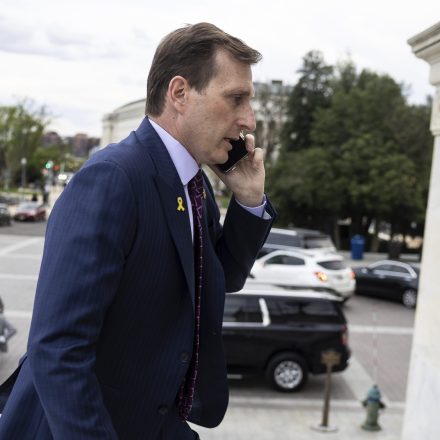
Joining Doggett during the floor debate was Rep. Don Beyer, D-Va., who had supported the earlier version of the nonprofit provision. In his remarks, Beyer pointed out that providing material support for terrorism is already illegal under U.S. law, but focused mostly on the looming return of Trump in explaining his opposition.
“In the hands of a responsible government, the powers provided with this bill are redundant and duplicative,” he said. “However, history is uncertain; democracies, even ours, can wax and wane. Sometimes we have great presidents, and sometimes we do not, and under the leadership of an unscrupulous or an authoritarian president, it’s not hard to imagine how that administration could use the powers in this bill to hinder or dismantle organizations they don’t like.”
The majority of Democrats in the House agreed, despite most of them having supported the previous iteration of the bill. Just 52 Democrats wound up backing the bill, including right-leaning members such as Henry Cuellar, D-Texas, and pro-Israel stalwarts like Ritchie Torres, D-N.Y. But the list also included vehement anti-Trump partisans, including Adam Schiff, D-Calif.
There were other surprises: One prominent supporter of the bill who dropped her support at the last minute was Dina Titus, D-Nev., one of two Democrats to co-sponsor the bill. Titus had told The Intercept as recently as Friday that she continued to support the bill due to the provision on hostage tax relief, but when it came time to vote on Tuesday, she voted “nay.”
“I voted no on HR 9465. The bill contains provisions I support that provide essential tax relief to Americans wrongfully detained and held hostage, but I voted against it in light of recent concerns that the provisions added by Republicans related to non-profit tax-exempt status could be abused by a future administration,” Titus said in a statement to The Intercept after the vote.
The lone GOP “nay” vote came from Kentucky Rep. Thomas Massie, a tea party alum with a libertarian bent who has repeatedly broken with his party’s staunch support for Israel.
It’s unclear if or how the bill’s supporters — including its author, Rep. Claudia Tenney, R-N.Y., and co-sponsor Brad Schneider, D-Ill. — plan to advance it. The bill could easily return in the next legislative session. But the rallying of Democratic opposition and the loss of a Democratic co-sponsor indicate that it is unlikely to enjoy its previous bipartisan backing, according to Kia Hamadanchy, a senior policy counsel with the ACLU.
“We will remain vigilant as we expect it may very well return at some point,” Hamadanchy told The Intercept. “But the House has made clear that there will be no fast tracking of this legislation and we will continue our sustained opposition.”
Update: November 13, 2024
The article was updated with a quote from Nevada Rep. Dina Titus that was received after publication.
IT’S EVEN WORSE THAN WE THOUGHT.
What we’re seeing right now from Donald Trump is a full-on authoritarian takeover of the U.S. government.
This is not hyperbole.
Court orders are being ignored. MAGA loyalists have been put in charge of the military and federal law enforcement agencies. The Department of Government Efficiency has stripped Congress of its power of the purse. News outlets that challenge Trump have been banished or put under investigation.
Yet far too many are still covering Trump’s assault on democracy like politics as usual, with flattering headlines describing Trump as “unconventional,” “testing the boundaries,” and “aggressively flexing power.”
The Intercept has long covered authoritarian governments, billionaire oligarchs, and backsliding democracies around the world. We understand the challenge we face in Trump and the vital importance of press freedom in defending democracy.
We’re independent of corporate interests. Will you help us?
IT’S BEEN A DEVASTATING year for journalism — the worst in modern U.S. history.
We have a president with utter contempt for truth aggressively using the government’s full powers to dismantle the free press. Corporate news outlets have cowered, becoming accessories in Trump’s project to create a post-truth America. Right-wing billionaires have pounced, buying up media organizations and rebuilding the information environment to their liking.
In this most perilous moment for democracy, The Intercept is fighting back. But to do so effectively, we need to grow.
That’s where you come in. Will you help us expand our reporting capacity in time to hit the ground running in 2026?
We’re independent of corporate interests. Will you help us?

I’M BEN MUESSIG, The Intercept’s editor-in-chief. It’s been a devastating year for journalism — the worst in modern U.S. history.
We have a president with utter contempt for truth aggressively using the government’s full powers to dismantle the free press. Corporate news outlets have cowered, becoming accessories in Trump’s project to create a post-truth America. Right-wing billionaires have pounced, buying up media organizations and rebuilding the information environment to their liking.
In this most perilous moment for democracy, The Intercept is fighting back. But to do so effectively, we need to grow.
That’s where you come in. Will you help us expand our reporting capacity in time to hit the ground running in 2026?
We’re independent of corporate interests. Will you help us?
Related

They Planned to Deliver Aid to Gaza by Sea — Then Turkey Shut Them Down

October 7 Survivors Sue Campus Protesters, Say Students Are “Hamas’s Propaganda Division”

The “Pro-Israel” Smear Campaign to Cancel a Global Charity

Palestinian Rights Groups That Document Israeli Abuses Labeled “Terrorists” by Israel
Latest Stories

License to Kill
CIA Was Behind Venezuela Drone Strike, Source Says
The December 24 drone strike in Venezuela is the latest in a long tradition of CIA interventions in Latin America — which often lead to destabilization and blowback.

Midterms 2026
AIPAC Is Retreating From Endorsements and Election Spending. It Won’t Give Up Its Influence.
The lobbying group is taking a quieter approach this midterms cycle, but it’s still seeking to keep Congress in Israel’s pocket.

License to Kill
Did Trump Just Confess to Attacking Venezuela?
“They have a big plant or a big facility where the ships come from. Two nights ago, we knocked that out. We hit them very hard.”