
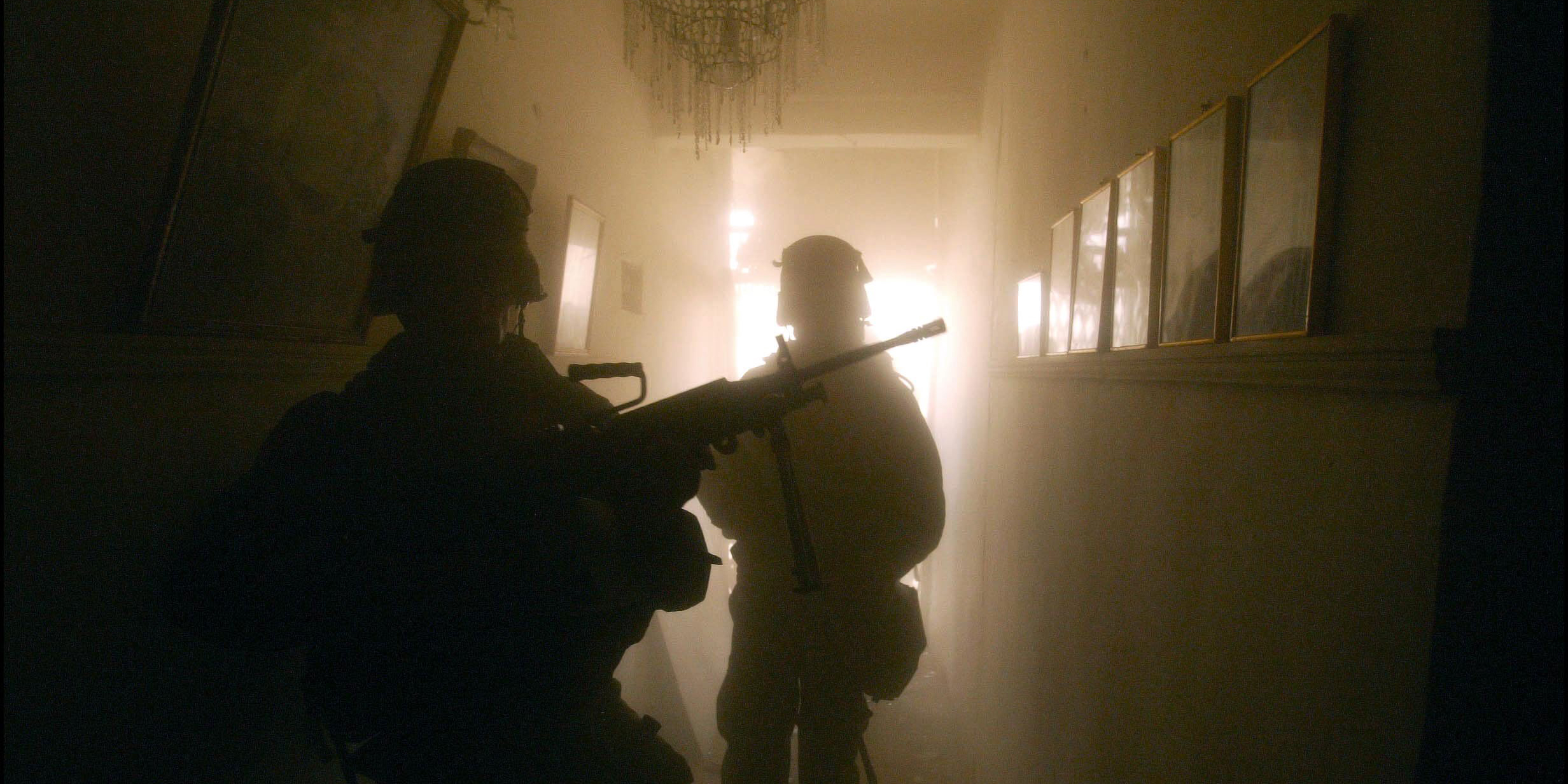
Tim McLaughlin commanded a Marine Corps tank platoon that took part in some of the earliest fighting of the U.S. invasion of Iraq. Like many veterans, the experience left him with post-traumatic stress and conflicted feelings about the war. In an attempt to process his experiences, after his service, McLaughlin left the U.S. and moved to Bosnia, where he lived for nine months in a home looking over the old city of Sarajevo — a place that, like Iraq, had been the site of terrible violence.
“I just wanted to be able to go to a country that had experienced mass trauma and to see how people dealt with it,” McLaughlin said. “What I learnt is that for people who experience it, trauma never goes away.”
Twenty years since U.S. troops first invaded, the U.S. war in Iraq has become a faded memory to many Americans. For Iraqis themselves, the consequences of the war are still an unavoidable part of their daily lives. But trauma also lingers for a group of Americans unlikely to forget the war as long as they live: former U.S. service members. More than a million Americans are estimated to have served in Iraq over the course of more than a decade, mostly in noncombat roles. Alongside millions of Iraqis who were killed or displaced by the conflict, thousands of Americans died or were wounded in Iraq.
For many veterans, the war has been the defining event of their lives. Yet it has been difficult to reconcile the terrible sacrifices they made during the conflict with the unhappy outcome or the false narratives that initiated it.
“The idea of going to war is horrible. When people are talking about it on TV, they are talking about something that is not real to them. When it becomes real to you, it stays real to you your whole life,” said McLaughlin. “For me, the experience was violent, stressful, and sad. I truly believe that we were the best in the world at our job and what we did. Unfortunately, the job of the Marine Corps was killing people and destroying stuff.”
In the years after the conflict, McLaughlin struggled with what he had experienced in Iraq. He later published his diaries, documenting the violence and terror of the early days of the invasion. He has also grappled with the tragic nature of the war for Iraqis, who, due to the decision to invade by the Bush administration, were forced to suffer for the September 11 attacks despite having no connection to them.


“I didn’t decide to invade Iraq. I have no negative feelings towards Iraqis at all. The people I served with who are alive, I love and adore. The people who are dead and gone, I love and adore,” said McLaughlin. “Where I do get frustrated is with the people who chose to do this. I just had a job. The people in Iraq were just living their lives. I do get frustrated with the people who made this decision. I mean, you sent us to invade the wrong country.” An Iraqi family reacts after three family members, innocent civilians, were shot and killed by U.S. Marines in an incident in Baghdad, Iraq, on April 9, 2003. (Photo by Carolyn Cole/Los Angeles Times via Getty Images)

Hell for Life
The initial claim that launched the war, which was that Iraq harbored weapons of mass destruction and posed an imminent threat to the United States and its allies, was disproved early on in the conflict. What Americans and Iraqis were then left to experience was a slow, grinding military occupation and insurgency, fought without a clear purpose, which gradually devolved into a civil war that left millions dead, wounded, or displaced.
At the end of all the bloodshed, Saddam Hussein and his family were gone, but life in Iraq today remains difficult for many who have had to deal with the aftermath of the war (and there are still approximately 2,500 U.S. troops in Iraq as trainers and advisers to the Iraqi military). Many Americans who had joined the military out of a sense of national duty following September 11 found themselves killing and dying in a war against people who had had nothing to do with the attacks.

“For people who had enlisted in the aftermath of 9/11 with the intention of avenging the attacks, to then end up in Iraq — which had very little or nothing to do with it — it is very difficult to reconcile,” said Gregory Daddis, a former U.S. Army colonel and veteran of both Operation Desert Storm and Operation Iraqi Freedom who later served as a military historian. “You have veterans now dealing with their experiences and trying to answer the question of whether their sacrifices were worth it. With wars like Iraq, Afghanistan, and Vietnam, it is very difficult to answer that in a positive way.”
In addition to hundreds of thousands of Iraqis killed in the war, it is estimated that roughly 4,500 U.S. service members died in Iraq. Many thousands more were wounded, often with debilitating injuries that have required long-term care and made a return to normal life impossible. Despite whatever support they may receive from the federal government, the catastrophic wartime injuries that many Americans in Iraq suffered has been beyond what even attentive medical service can heal. Some are still dying today as a result of wounds suffered during combat. While the war may be disappearing from the memory of Americans, these injuries and traumas are a daily reminder of the legacy of the Iraq War to those who experienced it firsthand.
Dennis Fritz served as an U.S. Air Force officer for 28 years before resigning in the early days of the war and spending over a decade working at the Warrior Clinic at Walter Reed Military Hospital, helping with the recovery of service members wounded in Iraq and other conflicts. The experience of dealing with a constant stream of grievously wounded service members has fed a sense of anger on behalf of soldiers manipulated by political leaders who made the decision to invade Iraq.
“I’m upset about it to this day because our service members were used as pawns.”
“Most Americans don’t even understand that war is real when they are watching it on television. It is only when they come to Walter Reed to see a family member who lost a limb or had PTSD that they realize,” said Fritz, who retired from the Air Force at the rank of master sergeant and now does writing and public advocacy on behalf of veterans in favor of military restraint. “We have people who suffer wounds that mean it’s going to be hell for them for the rest of their lives. Meanwhile, as we now know, Iraq was no threat to us. I’m upset about it to this day because our service members were used as pawns.”
Many of those responsible for the Iraq War have gone on to enjoy rewarding careers as senior policymakers in Washington or have cashed in on their time in government by taking well-paid roles in the private sector. Meanwhile, the trail of suffering left behind by the conflict continues to claim victims, both in the Middle East, where the consequences of the war are still felt by millions, and in the towns and cities of the United States, where the physical and psychological wounds of the war are still quietly carried by many veterans.
“I know two people who were officers during the war and are going through a hard time with PTSD right now and the guilt that they feel because their soldiers lost their lives,” Fritz said. “But it’s not because of them that they died; it’s because of the political leaders who sent them to war on a lie. They’re ones who should have PTSD — but they don’t. They just go off to write books and get themselves lucrative jobs.”
IT’S EVEN WORSE THAN WE THOUGHT.
What we’re seeing right now from Donald Trump is a full-on authoritarian takeover of the U.S. government.
This is not hyperbole.
Court orders are being ignored. MAGA loyalists have been put in charge of the military and federal law enforcement agencies. The Department of Government Efficiency has stripped Congress of its power of the purse. News outlets that challenge Trump have been banished or put under investigation.
Yet far too many are still covering Trump’s assault on democracy like politics as usual, with flattering headlines describing Trump as “unconventional,” “testing the boundaries,” and “aggressively flexing power.”
The Intercept has long covered authoritarian governments, billionaire oligarchs, and backsliding democracies around the world. We understand the challenge we face in Trump and the vital importance of press freedom in defending democracy.
We’re independent of corporate interests. Will you help us?
IT’S BEEN A DEVASTATING year for journalism — the worst in modern U.S. history.
We have a president with utter contempt for truth aggressively using the government’s full powers to dismantle the free press. Corporate news outlets have cowered, becoming accessories in Trump’s project to create a post-truth America. Right-wing billionaires have pounced, buying up media organizations and rebuilding the information environment to their liking.
In this most perilous moment for democracy, The Intercept is fighting back. But to do so effectively, we need to grow.
That’s where you come in. Will you help us expand our reporting capacity in time to hit the ground running in 2026?
We’re independent of corporate interests. Will you help us?

I’M BEN MUESSIG, The Intercept’s editor-in-chief. It’s been a devastating year for journalism — the worst in modern U.S. history.
We have a president with utter contempt for truth aggressively using the government’s full powers to dismantle the free press. Corporate news outlets have cowered, becoming accessories in Trump’s project to create a post-truth America. Right-wing billionaires have pounced, buying up media organizations and rebuilding the information environment to their liking.
In this most perilous moment for democracy, The Intercept is fighting back. But to do so effectively, we need to grow.
That’s where you come in. Will you help us expand our reporting capacity in time to hit the ground running in 2026?
We’re independent of corporate interests. Will you help us?
Contact the author:

Related


Latest Stories

License to Kill
CIA Was Behind Venezuela Drone Strike, Source Says
The December 24 drone strike in Venezuela is the latest in a long tradition of CIA interventions in Latin America — which often lead to destabilization and blowback.

Midterms 2026
AIPAC Is Retreating From Endorsements and Election Spending. It Won’t Give Up Its Influence.
The lobbying group is taking a quieter approach this midterms cycle, but it’s still seeking to keep Congress in Israel’s pocket.

License to Kill
Did Trump Just Confess to Attacking Venezuela?
“They have a big plant or a big facility where the ships come from. Two nights ago, we knocked that out. We hit them very hard.”