
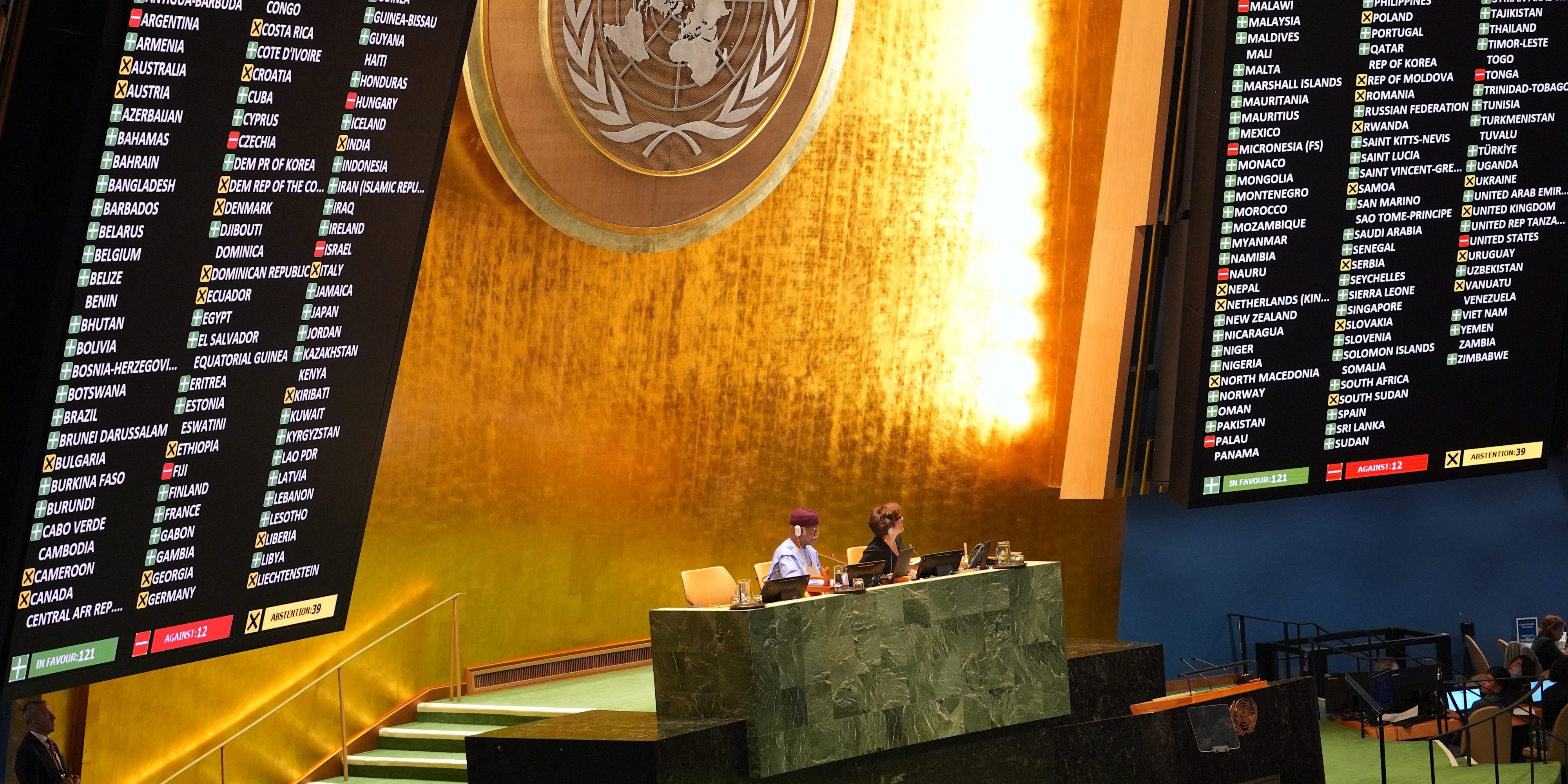
The United Nations passed a historic resolution Wednesday that calls for the end of Israel’s occupation of Palestinian territories in the West Bank, East Jerusalem, and Gaza, with 124 of the 181 member states voting in favor of the measure.
The United States, alongside 13 other nations, voted against the resolution, continuing its unconditional support for Israel’s actions in Palestine.
The sweeping resolution builds on an unprecedented July 19 ruling from the U.N.’s top court, the International Court of Justice, which declared Israel’s occupation of Palestinian territories as an illegal, apartheid system that must cease. The latest resolution, introduced by Palestine, affirms the July ruling, setting a 12-month timeframe for the withdrawal of Israeli military from the Occupied Palestinian Territory, including the removal of Israeli settlers, a halt to Israel’s annexation of Palestinian land, as well as the return of land seized from Palestinians since the occupation began in 1967.
Wednesday’s vote had 124 nations in favor of the resolution, 14 against, and 43 abstaining. In addition to the United States and Israel, the coalition of 14 nations opposing the resolution included just two European states, Czechia and Hungary; two South American countries, Argentina and Paraguay; the African nation of Malawi; Papua New Guinea; and six tiny Pacific Island nations.


“This resolution makes it abundantly clear that the vast majority of the international community support the findings of the International Court of Justice that Israel’s 57-year occupation of the Occupied Palestinian Territory is a violation of international law and should not be allowed to continue,” said Jessica Peake, an international law professor at UCLA Law, adding that vote is “historic” given Palestine’s status as a new member of the United Nations General Assembly.
After the assembly approved a resolution — despite U.S. opposition — in May, the State of Palestine has been seated among member states and given the right to introduce proposals and participate in committees, but still cannot vote.
However, the U.N. resolution, much like the U.N. court’s July opinion, is not legally binding, and the U.N. has no way of enforcing its rulings.
“And so now it’s on other member states in the international community to really put pressure on Israel and its allies to make that happen,” Peake said. She mentioned potential levers to get Israel to act, such as countries more vocally urging the end of the illegal occupation, withholding military aid, and issuing further sanctions. The United States sends billions of dollars of military aid to Israel each year.

Much of the opposition against the resolution had to do with its scope, with some nations arguing it goes beyond what the July advisory opinion asks for. Nations who voted against the resolution, or abstained, criticized the 12-month timeframe of ending the occupation as unrealistic and said Israel needs to be a more significant negotiating partner. U.S. Ambassador to the U.N. Linda Thomas-Greenfield previously said the resolution further undermines efforts to negotiate a two-state solution. President Joe Biden’s administration, much like previous administrations, has said it supports Palestinian sovereignty and a two-state solution but has yet to lay out any viable path toward accomplishing it.
Further obscuring any efforts toward Palestinian statehood, Thomas-Greenfield said during a panel at the Council of Foreign Affairs in New York that Palestine is not ready to be an independent nation. “I do not believe the Palestinians, as they exist right now, have all of the elements to give it statehood,” she said, adding that she had concerns around “issues of peace and security.”
Even so, Peake said the U.N.’s recognition of Israel as an occupying power is accurate and said the 12-month timeframe gives the resolution a needed deadline.
“Otherwise, we just have some rather nebulous statement that is encouraging Israel to withdraw,” she said. “I think it really helps us see 12 months from now, what has Israel done? It puts a time limit on it — it puts a moment in time where the international community can look at Israel’s behavior and take stock of has it, or has it not, fulfilled the recommendations that the General Assembly has made through this resolution.”
Ahead of the vote, more than 30 human rights groups released a letter urging U.N. members to vote in favor of the resolution, as well as the end of weapons sales and transfers to Israel. The letter listed violations of humanitarian law, such as the use of arms to attack Palestinian civilians, including children, arbitrarily imprisoning Palestinians, and the deprivation of freedom of movement and medical assistance.
“Failure to adhere to the ICJ’s advisory opinion will send a message that states can be selective in their application of international law,” the letter read. “It is imperative that states reinforce and show their commitment to international institutions and the international order that has been in place for nearly 80 years.”
IT’S EVEN WORSE THAN WE THOUGHT.
What we’re seeing right now from Donald Trump is a full-on authoritarian takeover of the U.S. government.
This is not hyperbole.
Court orders are being ignored. MAGA loyalists have been put in charge of the military and federal law enforcement agencies. The Department of Government Efficiency has stripped Congress of its power of the purse. News outlets that challenge Trump have been banished or put under investigation.
Yet far too many are still covering Trump’s assault on democracy like politics as usual, with flattering headlines describing Trump as “unconventional,” “testing the boundaries,” and “aggressively flexing power.”
The Intercept has long covered authoritarian governments, billionaire oligarchs, and backsliding democracies around the world. We understand the challenge we face in Trump and the vital importance of press freedom in defending democracy.
We’re independent of corporate interests. Will you help us?
IT’S BEEN A DEVASTATING year for journalism — the worst in modern U.S. history.
We have a president with utter contempt for truth aggressively using the government’s full powers to dismantle the free press. Corporate news outlets have cowered, becoming accessories in Trump’s project to create a post-truth America. Right-wing billionaires have pounced, buying up media organizations and rebuilding the information environment to their liking.
In this most perilous moment for democracy, The Intercept is fighting back. But to do so effectively, we need to grow.
That’s where you come in. Will you help us expand our reporting capacity in time to hit the ground running in 2026?
We’re independent of corporate interests. Will you help us?

I’M BEN MUESSIG, The Intercept’s editor-in-chief. It’s been a devastating year for journalism — the worst in modern U.S. history.
We have a president with utter contempt for truth aggressively using the government’s full powers to dismantle the free press. Corporate news outlets have cowered, becoming accessories in Trump’s project to create a post-truth America. Right-wing billionaires have pounced, buying up media organizations and rebuilding the information environment to their liking.
In this most perilous moment for democracy, The Intercept is fighting back. But to do so effectively, we need to grow.
That’s where you come in. Will you help us expand our reporting capacity in time to hit the ground running in 2026?
We’re independent of corporate interests. Will you help us?
Contact the author:

Related


Latest Stories

License to Kill
CIA Was Behind Venezuela Drone Strike, Source Says
The December 24 drone strike in Venezuela is the latest in a long tradition of CIA interventions in Latin America — which often lead to destabilization and blowback.

Midterms 2026
AIPAC Is Retreating From Endorsements and Election Spending. It Won’t Give Up Its Influence.
The lobbying group is taking a quieter approach this midterms cycle, but it’s still seeking to keep Congress in Israel’s pocket.

License to Kill
Did Trump Just Confess to Attacking Venezuela?
“They have a big plant or a big facility where the ships come from. Two nights ago, we knocked that out. We hit them very hard.”